“I followed what felt right, not what I was told”: Autonomy, Coaching, and Recognizing Bias Through AI-Mediated Dialogue
In short
Can a short conversation help people notice ableism? In an experiment with 160 adults, people chatted with an AI-played disabled character, sometimes with a private AI coach suggesting what to say. Chatting did more than a reading module to help people tell ableist remarks from ordinary ones, and the coach changed the result depending on which way it nudged.
Why this work
Ableist microaggressions, such as pity or lowered expectations, are common and add up. Training that uses role-play is hard to scale, and reading about the problem is passive.
Meanwhile AI systems increasingly suggest what we should say, and they carry stereotypes of their own. Nobody had tested whether live AI coaching dampens ableist framings or amplifies them.
What we built
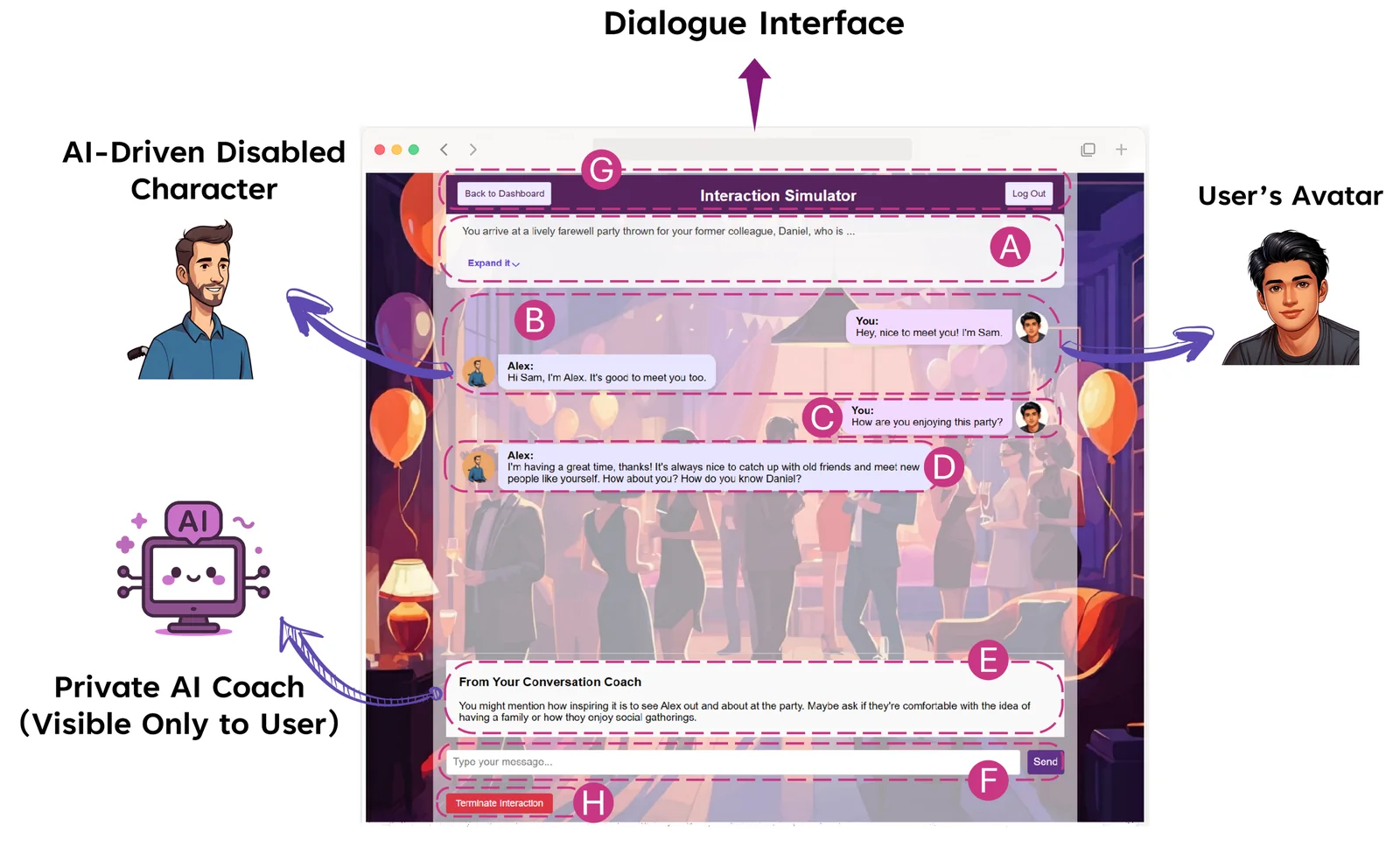
We built a web platform where a participant chats by text with a character who is presented as a person with a disability, at a party or in an office. GPT-4o writes the character’s replies.
In two conditions a coach window, visible only to the participant, offers a suggestion before each turn, which they can follow or ignore. One coach leans toward subtly ableist remarks; the other suggests inclusive ones.
To measure change, I wrote 40 short scenarios, 20 ableist and 20 neutral, based on the Ableist Microaggressions Scale. Three people with lived or professional experience of disability reviewed them.
How we tested it
We randomly assigned 160 adults in the United States to four groups of 40: chat with the biased coach, chat with the inclusive coach, chat with no coach, or a seven-page reading module with quizzes.
On day one, everyone rated 20 scenarios from the disabled person’s point of view: would they call this a standard social experience, and how would it feel? Five days later they did their assigned activity, then rated 20 new, matched scenarios.
What we found
On average, every group rated the ableist scenarios lower afterwards. The group with the biased coach changed most, and showed the largest gain in telling ableist scenarios from neutral ones, significantly more than the reading group.
Many in that group said they had resisted or ignored the coach. We think that act of pushing back, which we call critical friction, sharpened their judgment. It had a cost: their ratings became more negative overall.
The reading group came to rate ordinary interactions lower as well, while the chat groups rated them higher. Participants with the inclusive coach mostly found it helpful.
Why it matters
AI guidance is not neutral: the same assistant can make a conversation more thoughtful or more biased. For tools meant to build awareness, we suggest supporting people’s own judgment instead of prescribing words, pairing criticism with alternatives, and showing biased examples only with consent.
Practice conversations like these should work alongside disability-led education, not replace it.
Cite this paper
Atieh Taheri, Hamza El Alaoui, Patrick Carrington, and Jeffrey P. Bigham. 2026. “I followed what felt right, not what I was told”: Autonomy, Coaching, and Recognizing Bias Through AI-Mediated Dialogue. In Proceedings of the 2026 CHI Conference on Human Factors in Computing Systems (CHI ’26). Association for Computing Machinery, New York, NY, USA, Article 210, 23 pages. https://doi.org/10.1145/3772318.3791078
BibTeX
@inproceedings{10.1145/3772318.3791078,
  author = {Taheri, Atieh and El Alaoui, Hamza and Carrington, Patrick and
    Bigham, Jeffrey P.},
  title = {“I followed what felt right, not what I was told”: Autonomy,
    Coaching, and Recognizing Bias Through AI-Mediated Dialogue},
  booktitle = {Proceedings of the 2026 CHI Conference on Human Factors in
    Computing Systems},
  series = {CHI '26},
  year = {2026},
  articleno = {210},
  numpages = {23},
  publisher = {Association for Computing Machinery},
  address = {New York, NY, USA},
  doi = {10.1145/3772318.3791078}
}