StepWrite: Adaptive Planning for Speech-Driven Text Generation
In short
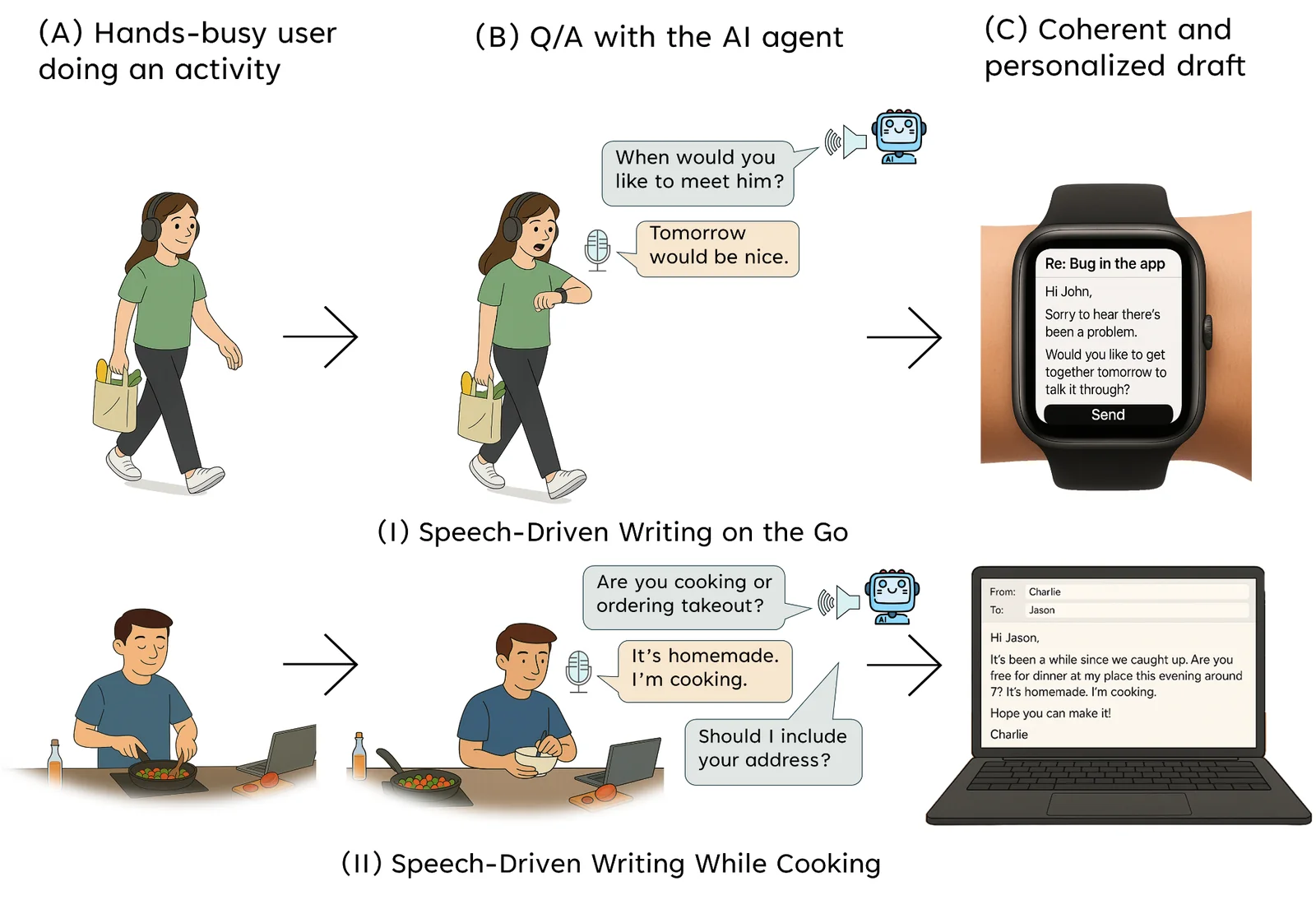
StepWrite lets you write a longer message by voice alone while your hands and eyes are busy. It asks short spoken questions one at a time, then writes the draft from your answers. In a study with 25 people, its drafts needed far fewer edits than dictated text.
Why this work
Voice tools handle short texts well. A longer, structured message needs planning, keeping track and revising, and that is hard when you cannot see the text.
Dictation only transcribes what you say, and conversational assistants leave the planning to you.
What we built
StepWrite is an open-source web app. A language model reads everything asked and answered so far and decides the next question, or decides that it knows enough to draft. It asks only for the facts, never for wording or style.
Questions are spoken aloud, and short voice commands let you skip a question, change an answer, pause or finish. When it drafts, StepWrite sticks to the facts you gave, picks a fitting tone and runs a fact-check pass that flags anything unsupported.
How we tested it
Twenty-five people each used StepWrite, ChatGPT’s Advanced Voice Mode and Microsoft Word dictation to write an invitation and to reply to an email. They did this while walking or with their hands occupied, then revised each draft by keyboard until they would send it.
What we found
Dictated drafts needed the most fixing: about eight to nine word-level edits on average, against about one for StepWrite and two for ChatGPT’s voice mode. StepWrite’s drafts also changed least in meaning during revision.
StepWrite was the slowest of the three, because of the questions, yet its average workload rating was the lowest. A manual wheelchair user noted how hard it is to stop and type on a phone, and a participant with a learning disability said the step-by-step questions helped them give fuller answers. Both point to accessibility as a direction for this work.
Cite this paper
Hamza El Alaoui, Atieh Taheri, Yi-Hao Peng, and Jeffrey P. Bigham. 2025. StepWrite: Adaptive Planning for Speech-Driven Text Generation. In Proceedings of the 38th Annual ACM Symposium on User Interface Software and Technology (UIST ’25). Association for Computing Machinery, New York, NY, USA, Article 86, 30 pages. https://doi.org/10.1145/3746059.3747610
BibTeX
@inproceedings{10.1145/3746059.3747610,
  author = {El Alaoui, Hamza and Taheri, Atieh and Peng, Yi-Hao and Bigham,
    Jeffrey P.},
  title = {StepWrite: Adaptive Planning for Speech-Driven Text Generation},
  booktitle = {Proceedings of the 38th Annual ACM Symposium on User Interface
    Software and Technology},
  series = {UIST '25},
  year = {2025},
  articleno = {86},
  numpages = {30},
  publisher = {Association for Computing Machinery},
  address = {New York, NY, USA},
  doi = {10.1145/3746059.3747610}
}