Virtual Steps: The Experience of Walking for a Lifelong Wheelchair User in Virtual Reality
In short
I have used a wheelchair all my life and have never walked. With my co-authors I designed a voice-controlled walking experience in virtual reality, and I kept a diary across nine days of using it. The diary shows which details make virtual walking feel right to someone with no physical memory of walking.
Why this work
VR walking systems are built and tested with people who walk, or who once did, so real walking is their yardstick. People who have never walked still carry a picture of what walking is like, formed by watching and being with others, and a system may not behave the way that picture expects.
Standard VR controllers also demand fine hand movement that many people with motor impairments do not have. Our aim was experience, not therapy.
What we built
The system runs on an Oculus Quest headset and is controlled by voice: go, stop, reverse, slow, and words for turning, with head movement for fine steering. Speech recognition kept mistaking “left” for “right”, so we replaced it with “lima” from the NATO phonetic alphabet.
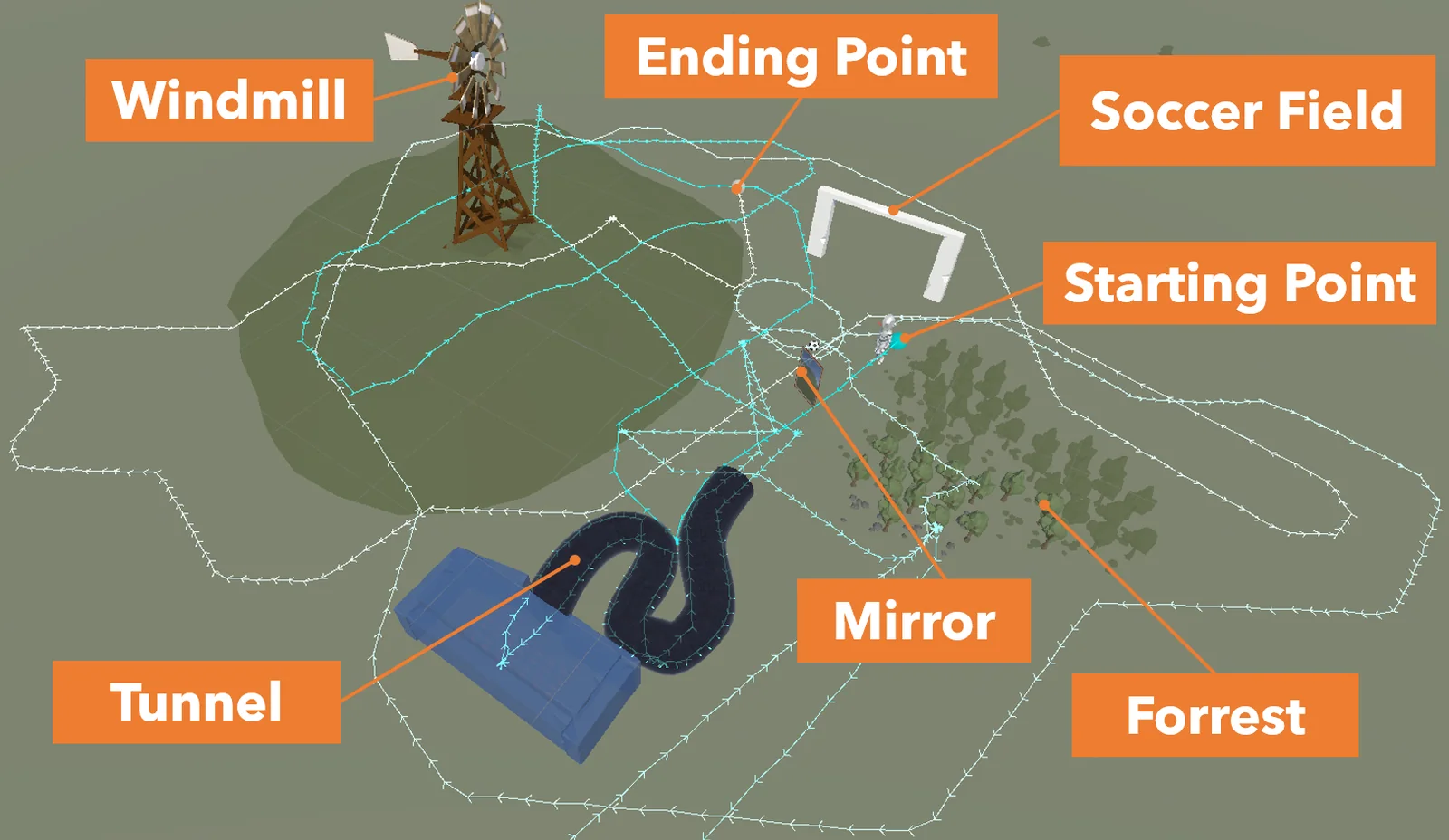
Three features could be switched on and off: a gentle head bob that imitates gait, footstep sounds, and a full-body avatar visible when looking down and in a virtual mirror. The world was a circular park with a soccer field, a forest, a tunnel and a hill with a windmill, and no game or goal attached.
How we studied it
I was the only participant, as well as a co-designer and co-author. Over nine days and nine versions of the system I used it for 3 hours and 45 minutes in total, and wrote a diary entry after each session.
Arthur Caetano, who developed the system, and I discussed each entry, and he built the next version. We each coded the diary independently and then merged our themes.
What we found
Emotion was the largest theme in the diary, followed by agency and control. Setting my own pace turned frustration into a feeling of freedom. Footsteps that fell out of time with the head bob sounded like someone else walking. With the head bob off, moving felt like rolling in my wheelchair; at a moderate setting it felt like walking.
On the fourth day I climbed the virtual hill and wrote that, for the first time, I knew how it felt to climb a hill under my own power. I never felt motion sickness.
Why it matters
The paper offers a first set of features and settings for VR walking for people with congenital motor and mobility impairments: a comfortable speed of about one metre per second, footsteps timed to the head bob, and the freedom to adjust everything.
It also suggests that a sense of agency can come from a person’s mental model of walking, even without a bodily memory of it. One person’s experience gives depth, not breadth, so we offer these findings as a starting point.
Cite this paper
Atieh Taheri, Arthur Caetano, and Misha Sra. 2024. Virtual Steps: The Experience of Walking for a Lifelong Wheelchair User in Virtual Reality. In 2024 IEEE Conference Virtual Reality and 3D User Interfaces (VR). IEEE, 168–178. https://doi.org/10.1109/VR58804.2024.00040
BibTeX
@inproceedings{10494131,
  author = {Taheri, Atieh and Caetano, Arthur and Sra, Misha},
  title = {Virtual Steps: The Experience of Walking for a Lifelong Wheelchair
    User in Virtual Reality},
  booktitle = {2024 IEEE Conference Virtual Reality and 3D User Interfaces
    (VR)},
  year = {2024},
  pages = {168--178},
  publisher = {IEEE},
  doi = {10.1109/VR58804.2024.00040}
}