Design and Evaluation of a Hands-Free Video Game Controller for Individuals with Motor Impairments
In short
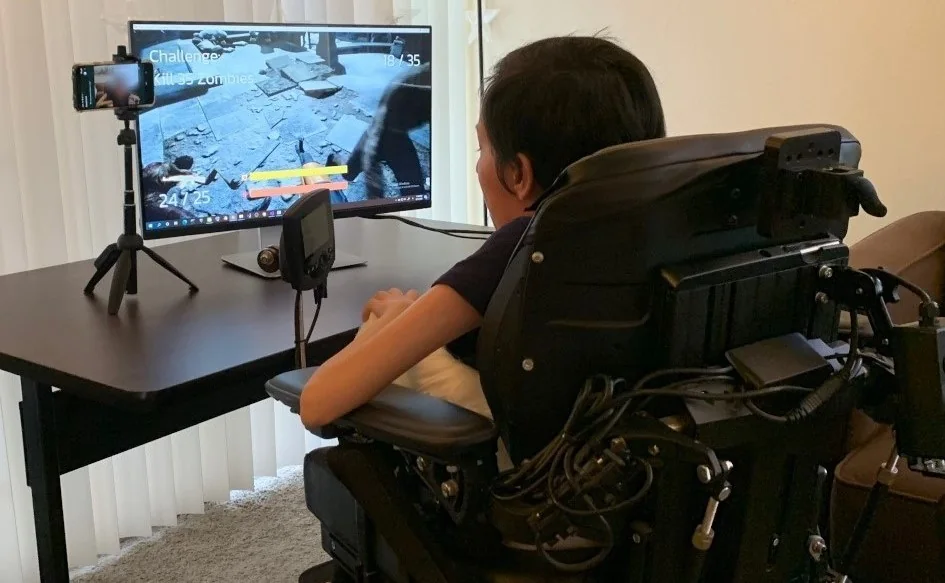
This paper tests the face-controlled game system with other players. Eight people with muscular dystrophy or spinal muscular atrophy used it at home to play a first-person shooter. They found it quick to learn and satisfying, and they wanted to choose their own expressions.
Why this work
Game input still assumes two hands. For people with severe motor impairments, existing assistive inputs are so limited that they often mean much simpler games, and in-game accessibility settings do not help when hands cannot be used at all.
We wanted independent play, at low cost, with nothing to wear.
What we built
The system detects facial expressions from a webcam and maps six of them to keys, with speech as a backup. This version adds head nods as another input, and a window where each key can be set to an expression or a nod, with its own sensitivity.
An expression must hold for five frames before it fires, our answer to the Midas-touch problem of triggering actions by accident. Players learned the controls in a walking game, then played a zombie shooter with auto-aim and on-and-off toggles for movement.
How we tested it
The system had been co-designed with one player. Here, eight others took part from home over Zoom, in two sessions on separate days, about three hours in all.
They installed and adjusted the system, played the tutorial, played the shooter, and then answered questionnaires on usability, user experience and game experience.
What we found
Participants rated learnability highest, and rated efficiency and satisfaction positively. On the game experience questions, enjoyment averaged 6.1 out of 7 and boredom 1.6. What people liked most was simply playing without their hands.
What they wanted was more personal control. The expression used for shooting had been easy for the co-designer and was the hardest for almost everyone else, so the mapping from expressions to actions has to be personal. Some also felt their face tire, which makes fatigue a design consideration.
Cite this paper
Atieh Taheri, Ziv Weissman, and Misha Sra. 2021. Design and Evaluation of a Hands-Free Video Game Controller for Individuals with Motor Impairments. Frontiers in Computer Science 3, Article 751455. https://doi.org/10.3389/fcomp.2021.751455
BibTeX
@article{10.3389/fcomp.2021.751455,
  author = {Taheri, Atieh and Weissman, Ziv and Sra, Misha},
  title = {Design and Evaluation of a Hands-Free Video Game Controller for
    Individuals with Motor Impairments},
  journal = {Frontiers in Computer Science},
  volume = {3},
  year = {2021},
  issn = {2624-9898},
  doi = {10.3389/fcomp.2021.751455}
}